


Defining success: and other things written in sand
A few months ago I disabled the ‘show likes’ facility on all my blog posts. Like many of us, the yardstick for measuring the ‘success’ of my writing had been reduced to how many people had ‘liked’ or shared something.
I was despairing about one particularly dreadful poem I’d trotted out as a haiku — it had been liked over 600 times, yet some of my best work (in my mind) remained unnoticed without a single uptick.

By all accounts our Century 21 view of success is linked to external recognition, affluence, popularity, and wealth — implying that anything unknown, amateur, or low budget could never be truly classed as ‘successful’.
Look at these beautiful definitions:
- Successful: having achieved fame, wealth, or social status. Oxford Dictionary of English.
- Successful: having succeeded in obtaining wealth, position, or the like. Macquarie Complete Australian Dictionary.
With authoritative definitions like these, how could my humble blog ever be considered more than a quaint hobby?
But I’ve been feeling quite empowered recently, after reading Eric Booth’s ‘The Everyday Work of Art: awakening the extraordinary in your everyday life’.
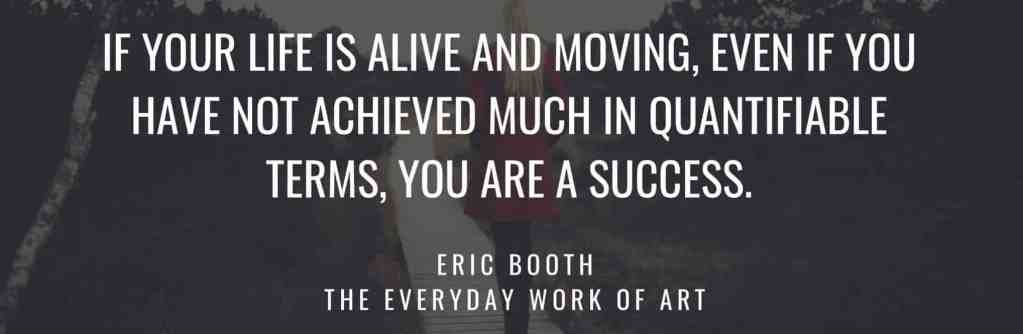
Mr Booth gives everyone permission to find success by continually moving toward personally important goals, without worrying about whether those goals are ever actually ‘achieved’. He believes, that in order to be successful you only have to be moving, growing, expanding, and exploring your creative possibilities.
What an inspiring concept!
Now I’m working with this new idea that success is linked to growth, personal recognition, and creative expression. That the opposite of success is not failure, but stasis. And even if failure were actually a thing, it could only ever be linked to not using your creative abilities at all.
Originally, ‘success’ had no positive or negative spin. It referred simply to the outflow from a situation. In its parentage, ‘success’ was the fortune (good or bad) following anyone in a particular situation; it was whatever succeeded, whatever followed. (The succession of kings had little to do with the monarch’s job performance review.)
Over time, however the usages of ‘success’ came to be limited to exclusively positive outcomes. More recently, it has taken on social cachet — being ‘a success’ is one of the great labels people seek to achieve.
Eric Booth, The Everyday Work of Art.
There is a passage in Stephen King’s ‘On Writing’ (the buzz-book of biblical standards in the writing world) where he tells us, unapologetically, that there are only 3 levels of writers. Bad. Good. And, Great.
Apparently a Bad writer can never become a Great writer. A Bad writer can at best expect to work their guts out and one day (maybe) find themselves a mid-level Good writer.
If you’ve ever read that book I suggest you rip those pages out immediately and throw them on the same rubbish pile where you threw all your creative writing dreams. You’ll find a few of mine in there too.
When I turned the ‘like’ feature off my blog posts I began giving myself permission to reject limiting definitions of creative worth and success. I invite you to as well.
How about recognising that writing success is about progress.
Like an eBook I self-published 2 years ago (and thought was awesome), I look at it now and cringe (Stephen King probably would too).
Or blogs I published back in 2014, by my standards now, I would never have even hit the publish button.
If we allow ourselves to get too caught up in this ‘popular’, ‘profitable’, and ‘public’ view of success we place such a major obstacle in front of ourselves it’s hard to write even a single sentence.

Greatness is within all of us, and now I’ve turned off the ‘like’ button I’m allowing my definition of great to be a private matter between me, and my creator.
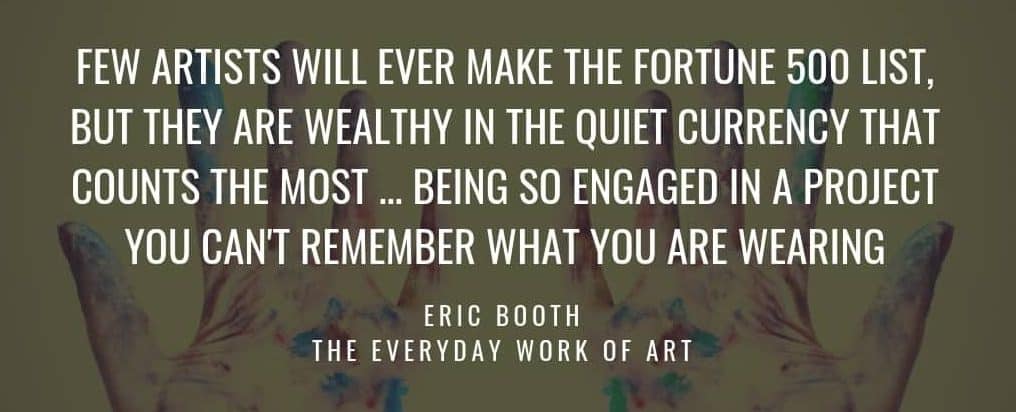
I’m defining my success by how often I access that ‘quiet currency’ described by Eric Booth. When I’m so engaged in a piece of writing — I look up from the screen — and the coffee shop around me is closing down, the staff are mopping the floor, and the till won’t take another pound, peso, or purple dollar.
LAST UPDATE: 23rd DECEMBER 2024
IMAGES: the featured image and base images behind the quotes were sourced from Canva.