


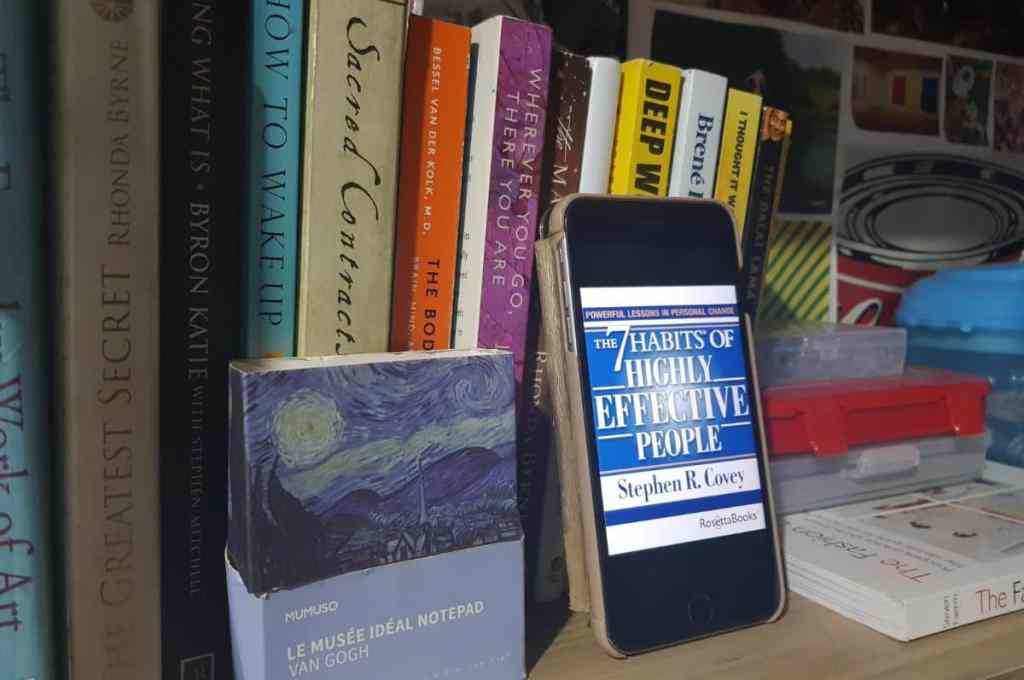
When I first began reading Stephen Covey’s 7 Habits of Highly Effective People in 2005 I was expecting a business book filled with business-speak success techniques. But instead I found a book about building character (and by default success) by applying 7 fundamental principles to the very essence of your life. Live in accordance with those principles and you could truly create an amazing life.
If you’ve been reading my blogs here you’ll know that I’m a keen reader and over the past year I read it again and have been referring to it ever since. I wanted to assess how much it had truly changed my behaviour since 2005 but I especially wanted to relate the principles to my own writing business. So here’s a few suggestions for how you could apply each of the 7 principles in the book to your own professional writing.
Proactive people carry their own weather with them, Whether it rains or shines makes no difference to them.
Stephen Covey (Habit #1 Be Proactive)
Habit 1: Be proactive
In 2018 if we are going to be successful writers and earn a full-time income we need a writing business. And we need to get on with it ourselves and innovate new ways of making money writing. There’s no room for excuses about the decline and closure of newspapers and bookshops, the fierce competition amongst freelancers, or the volumes and volumes of content out there. We must find a way ourselves.
As writers and authors being proactive means we take responsibility for growing an email list so we can build a relationships with our readers, and we don’t give up after the first publisher’s rejection email — or even the 100th ( J.K. Rowling’s original synopsis for the first Harry Potter book was rejected by 12 different publishers before being accepted by Bloomsbury). Copywriters will be cold-calling and pitching corporate business, and content writers can create an online portfolio of clips (beginning with guest posting for free on reputable websites).
NOTE: the world’s #1 bestselling author James Patterson had his first book rejected by 31 publishers. Once published it became a bestseller and won a series of crime fiction awards.
Proactive writers don’t wait to be discovered or even for the right time to start writing. We write. And we inherently know that the best writers are the ones who finish the book or the blog post and deeply understand that ‘if it’s to be, it’s up to me’.
Habit 2: Begin with the end in mind
When Stephen Covey described beginning with the end in mind, he projected us to our own funeral and how our life would be described in the eulogy. Ouch! When it comes to writing can we project ourselves that far forward?
How do we see our writing life? Can we visualise it clearly? What type of writer do we want to be? How much money do we want to earn every year? What is the writing project that burns deeply within us … a science fiction novel … an Oscar nominated screen-play … a short story in the New Yorker?
To begin with the end in mind means to start with a clear understanding of your destination — know where you’re going so that you better understand where you are now.
Stephen Covey (Habit #2 Begin With the End in Mind)
Covey tells us not to just look at our whole life, but to zoom in and apply that same principle to relationships and even writing projects. How does the book end? Does there need to be room for a sequel? What product is your client’s marketing email trying to sell? Do your client’s website keywords reflect the true nature of their business? Who is our audience? Why are we entering the poetry competition?
Do we really begin with the end in mind before we start writing?
He cautions us about being mindful in the way we create our every day life. And to especially remember that while we are climbing the ladder of writing success (because it’s so easy so caught in our crowded lives and the excitement of the project) — don’t get to the top only to discover our ladder has been leaning against the wrong wall.
Habit 3: Put first things first
As a writer, if we were to put first things first what would they be? Would we vigorously protect our daily writing practice from distractions and avoidable interruptions. Would we manage our time so we were able to be writing short-term (quick payment jobs) without neglecting long term big ticket projects like books or online courses? Would we create a morning ritual that began with 3 handwritten pages of notes?
Mr Covey reminds us that if Habit 1 (be proactive) means we are the creator of our life, and Habit 2 (begin with the end in mind) means we decide what to create, now Habit 3 (put first things first) means we have to get going and create that writing life. It means working on what’s really necessary to build the writing business we dreamed of and removing what isn’t.
What one thing could you do (something that you aren’t doing now) that, if you did on a regular basis, would make a tremendous positive different in your personal life?
Stephen Covey (Habit #3 Put First Things First)
How much time in our writing businesses are we spending answering emails, making phone calls, posting on social media, sending out proposals, vs actually writing? Are we balancing that out and allowing ourselves sufficient time to write on projects that bring in enough money to pay the bills at the end of the week?
Habit 4: Think Win/Win
Many of us writers begin our writing careers overwhelmed with an idea (often from a seeming divine source) that must be written down and shared at all costs. But Stephen Covey would consider this a ‘Win’ approach. By this he means consideration is only given to our ego and what we want for ourselves. But as writers, we should always be thinking about our readers. After all, who is going to read (and buy) our stuff?
Win/Win is a frame of mind and heart that constantly seeks mutual benefits from all human interactions.
Stephen Covey (Habit #4 Think Win/Win)
Writers and readers share the ultimate symbiotic relationship where one simply cannot exist without the other. And having a bunch of happy, engaged readers who regularly buy our material creates the perfect win-win. We then have the financial freedom to write and release more, and continue to entertain our readers.
Do you know exactly who you are writing for? Are you taking the time to know who are your most passionate readers.
And Habit 4: Think Win/Win is more than a technique to get to know our readers, it’s an overarching attitude really. Mr Covey calls it … a frame of mind and heart that constantly seeks mutual benefit in all human interactions … Win/Win sees life as a cooperative, not a competitive arena
Habit 5: Seek first to understand, then to be understood
Mr Covey says that communication is the most important skill in life. As writers I think we intuitively know this, because in order to write about anything we need a complete understanding of our subject matter and the facts (non-fiction writers), or our characters and the worlds we create for them (fiction). Here’s a couple of thoughts for applying habit # 5:
You’ve spent years learning how to read and write, years learning how to speak. But what about listening?
Stephen Covey (Habit #5 Week First to Understand)
Novelists: get into the head of your characters, understand who they are and how they would act in a range of situations. Eg, if your protagonist gets shot in the leg in Chapter Three, could she really run fast enough to get away from the out-of-control firetruck in Chapter Four?
Copywriters: understand your clients, get to know their products and the benefits of using their services. Know exactly what sales actions your client wants customers to take and what their main audience looks like.
SEO Content Writers: understand your key search terms and how readers use them to search for a book, product, or service. Strive to understand where the single web-page or blog post you are creating sits in the context of its industry, its market, and its geographic location.
Non-fiction writers: think about where your book, blog, or feature story sits in existing body of knowledge about the subject. Will it uncover facts? What new ideas will emerge? Will it change the way people think or act?
Habit 6: Synergise
No matter how you approach it, writing is a solitary activity. So how do writers make room in their lives to activate habit 6: to synergise and unlock the creative potential of harmonious collaboration? Maybe one of the best (and most obvious ways) is to work closely with an editor. Or at the very least have someone else to proofread your work.
Synery is everywhere in nature. If you plant two plants close together, the roots comingle and improve the quality of the soil so that both plants grow better than if they were separated.
Stephen Covey (Habit #6 Synergise)
Editors are paid professionals who scan your writing for errors as well as structural improvements. For novelists an editor will find inconsistencies in the plot and characters; for academics an editor will pinpoint flaws in logic; for non-fiction authors an editor will suggest ways to make the subject matter more accessible to a general audience.
The author-editor synergy will ultimately improve your writing: both the finalised manuscript and your overall approach to subsequent writing projects. I must get me one of them.
Habit 7: Sharpen the saw
It would be easy to think that ‘sharpening the saw’ in terms of our writing business is about attending writer’s workshops and finishing that BA (Creative Writing). Well yes it is — but Mr Covey’s seventh habit is as much about 

This is the single most powerful investment we can ever make in life — investment in ourselves, in the only instrument we have with which to deal with life and contribute.
Stephen Covey (Habit #7 Sharpen the Saw)
We need time to play, or take an artist date, have a vacation, and spend time with the people we adore. We also need to make sure we are getting enough sleep, green veggies, and exercise.
After 12 hours in front of a computer screen are we stretching our bodies or enjoying the intoxicating feeling of swimming in the ocean? Do we skip breakfast, or cleaning our teeth, or spending time with our creator in meditation and prayer?
Writing is our passion and if let it, our whole lives. Habit # 7 is a great reminder that a full and rich life contains many facets. Truly effective people (including writers) live by basic principles that enable an abundance of creativity alongside good health, peaceful relationships, plenty of time to write, and economic prosperity.

Final Thoughts
The most important habit is the one you are having the most difficult time living.
Stephen Covey (A Final Interview)
Which habit are you having the most difficult time living? For me it’s been ‘Habit 3: Putting First Things First’. How many days do I intend to get writing but end up caught in the habit of social media, emailing, and meaningless noise. This year (2019) I’m on a mission to sustain my writing habits and morning rituals through all that fuzzy stuff. How about you?